Hundred-gigabyte databases in R2, served live by one Durable Object.
The data sits in R2 as immutable 64 KB pages. One object serves it, holding only the pages queries touch. Every view on screen is a live query: when anyone writes, the object works out which rows of which open views changed and pushes just those. And every Hacker News story is now searchable by meaning, from the same pages.
How it works →
Four tiers, one fault round, writes that push only what changed, and folds back into R2. An animated walkthrough.
Vector search →
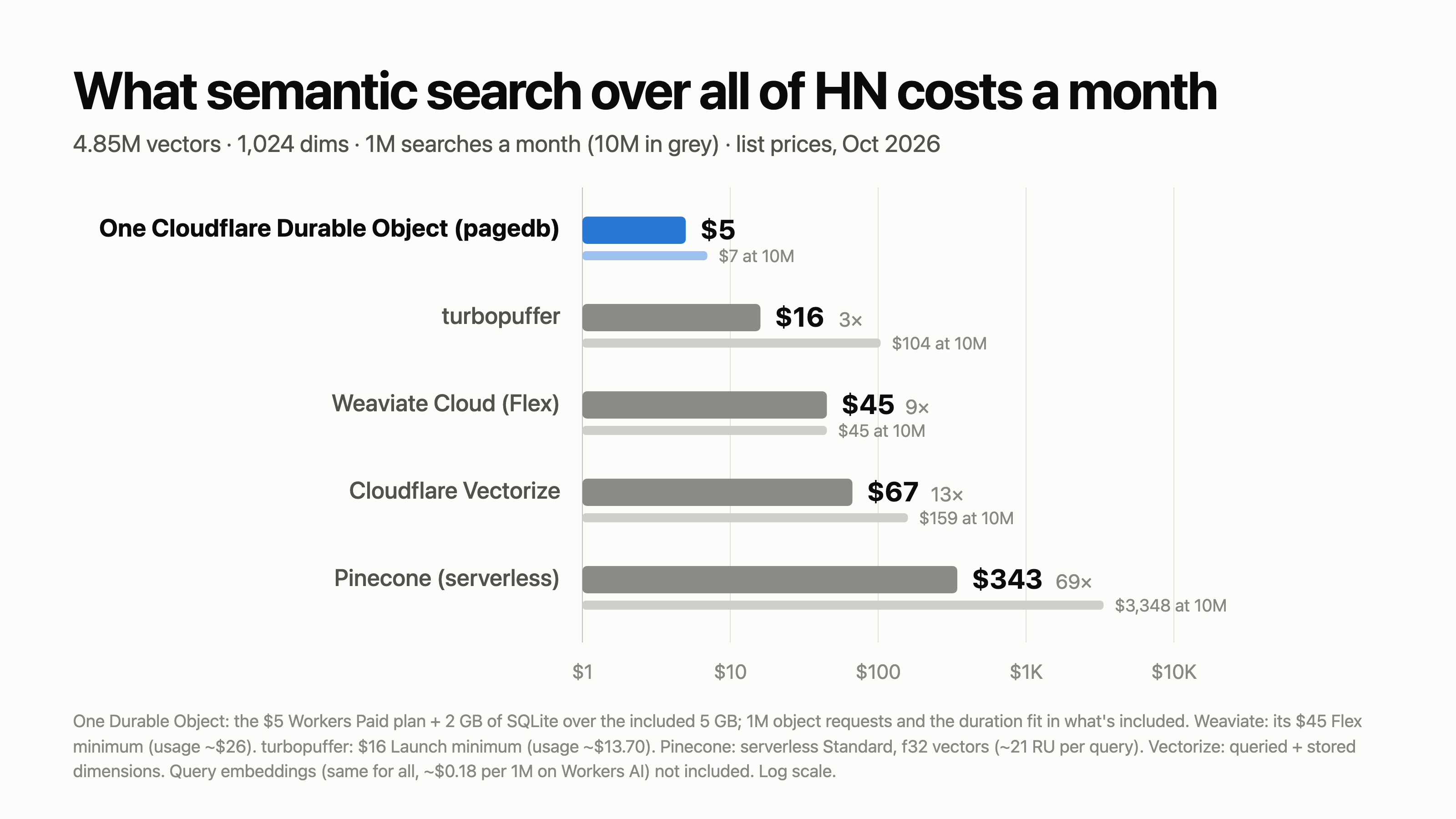
turbopuffer's design on Durable Objects: semantic search over 4.85M stories for ~$5 a month, and where turbopuffer still wins.
Numbers & limits →
Cost against Supabase, Convex, Pinecone and friends, benchmarks against r2db, and everything it can't do.
Live, right now
This page is a pagedb client. The search box below embeds your query and searches all 4.85M stories in the Hacker News object; the feed beside it is a live query on the same object, pushed as stories and comments arrive from HN.
Search Hacker News by meaning
Arriving on the HN object
How it works
A database whose base is immutable files in R2, and one object that serves it. Click a step, or let it play.
- A page asks for a named queryThe Worker checks the arguments and signs the query
- The socket subscribesOne Durable Object holds every live view
- RAM, then the object's SQLiteSynchronous, microseconds
- Misses become one fault roundEvery missing page, fetched together
- A write lands in the overlayDurable in SQLite when acknowledged
- Only changed rows are pushedTo every tab whose view they touch
- The overlay folds into R2Writes leave the object's memory
- Vector search: same pagesCentroids pinned, two stages, one round each
The long version, with every mechanism and measurement: how pagedb works.
Four demos, one engine
The schema is data, so the same engine and the same Durable Object code serve all four. Open one in two windows and edit in one.
Hacker News, live
Every story and comment since 2006. Search by title or by meaning; new items stream in from the HN API.
Issue tracker
Lists, boards and threads, all live. Every list and count is one fault round from cold.
r/place 2022
Every placement. Click a pixel for its history, scrub the timelapse, paint with everyone else.
NYC taxi sheet
One spreadsheet. Jump to row 73,000,000; group counts come from branch pages, without reading a row.
Vector search, in the same pages
turbopuffer's architecture rebuilt on Durable Objects + R2: an IVF index made of ordinary B+tree pages, next to the rest of the database. Same 1,024-d Qwen3 vectors, benchmarked against turbopuffer and Cloudflare Vectorize.
| Same 4.85M vectors, 100 queries | pagedb | turbopuffer | Vectorize |
|---|---|---|---|
| recall@10 vs exact | 0.971 | 0.990 | 0.786 |
| p50 in the service, new query | 138 ms | 13 ms | 465 ms |
| same query again | 38 ms (RAM) | 13 ms | 25 ms (cached) |
| filtered (before 2011) | 140 ms · 0.89 | 13 ms · 0.91 | 10.2 s · 0.72 |
| a write searchable | next search | next search | 14 s p50 |
| live result updates | yes | no | no |
| a month at 1M searches | ~$5 | $16 | ~$67 |
Two stages. The probe tier keeps 1 bit per dimension of each vector's rotated residual (RaBitQ-style, 128 bytes a story), scored with popcounts. The best 100 are rescored with 8-bit codes. Going from 4-bit codes to this took recall from 0.895 to 0.971 at the same page budget.
One round per stage. The 14,276 centroids are pinned in the object; a search picks the clusters within 256 pages, fetches every missing page at once, then fetches the candidates' 8-bit entries.
Writes are vectors too. The HN tail embeds each new story (Workers AI, Qwen3) in the same write as its row, so it's searchable on the next search and pushed into open results.
Where it tops out. The fast tier is the object's 10 GB of SQLite; this index is 7 GB. A small collection (under ~500k vectors) can skip the clusters entirely: all 1-bit codes in memory, brute force, a few ms.
The numbers
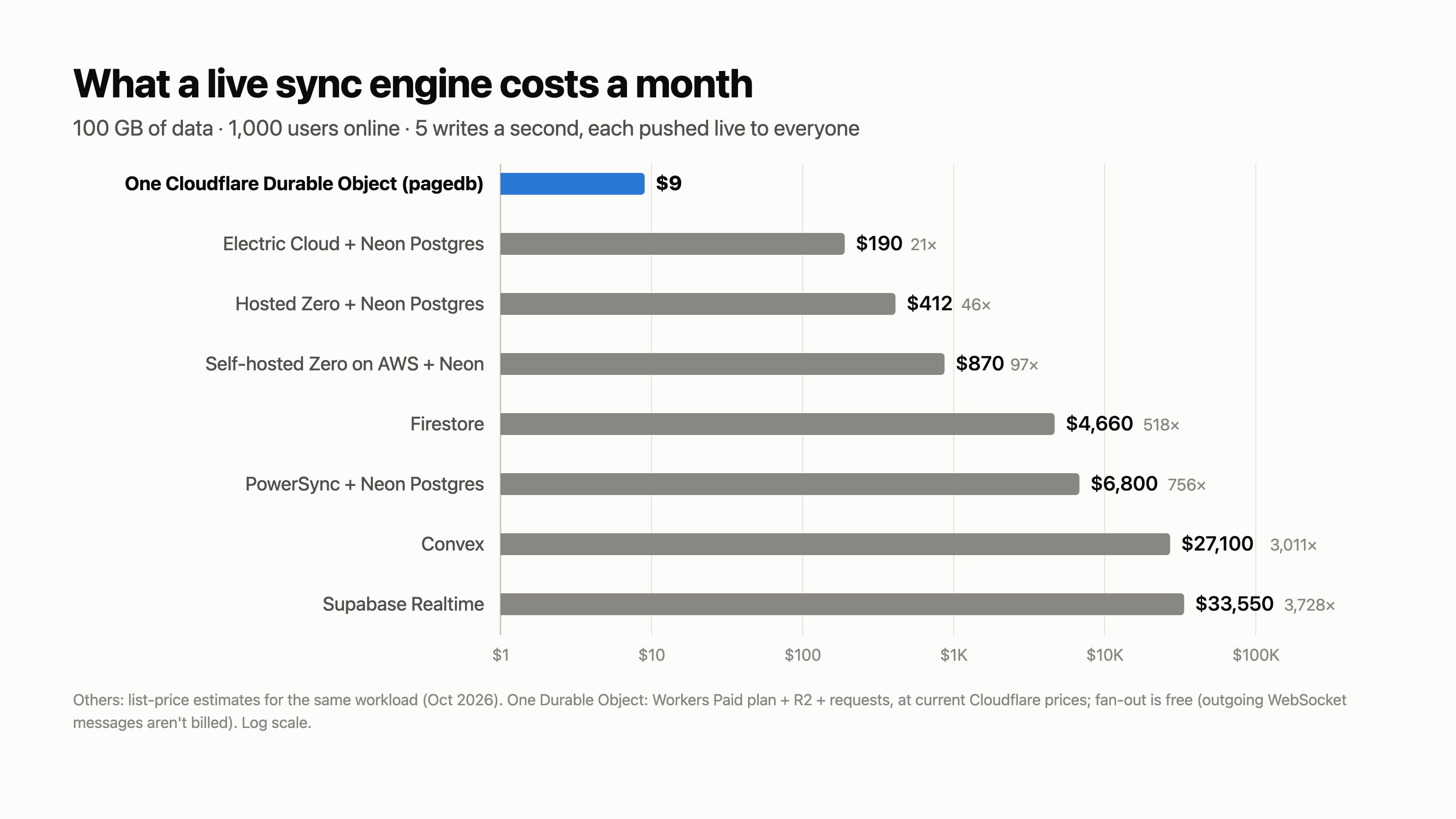
What a live sync engine costs at 100 GB and 1,000 concurrent users, and how pagedb compares with r2db, the demo that started this.
| Measured (same laptop) | pagedb | r2db demo |
|---|---|---|
| Issues on screen after opening the page (100 GB bases, median of 8 loads) | 0.25 s | 1.09 s |
| Every list, board column and count query from cold | 1 fault round | rounds = dependency depth |
| Count of a project's issues | 3.6 µs engine time | 3 ms (published) |
| Your own edit visible | instant (optimistic) | after the server round trip |
| Write → other tabs, 1,000 sockets, 5 writes/s | p50 174 ms | — |
What it can't do
- Only queries the app defines. Each list is a named query with an index behind it; a new kind of query means a new index and a rebuild.
- One object, one thread, one region. No replicas yet: about 7 fresh vector searches a second before they queue, and every read and write goes through one CPU.
- The base is built offline. 100 GB bases come from a builder in a container. New writes fold into layers in R2 at 4 MB, but rebuilding the base itself is a batch job.
- 128 MB of memory. The engine's page cache is 40 MiB; everything else pages through SQLite, the city cache or R2. Cold reads from R2 cost ~0.2 s a round.
- 10 GB of SQLite per object. That's the fast tier. Bigger hot sets need more objects.
- Vector search trails turbopuffer on recall (0.971 vs 0.990) and speed (138 vs 13 ms), and filters only on columns the index carries.